Pool Salt. What is the real story. What salt can I use in my pool?

There have been a lot of questions about pool salt and what types are okay to use with a salt chlorination system. I am writing today with recommendations for a Watermaid system. Other manufacturers will have their own opinion on the type of salt that should be used. Other systems may operate using the same principals but it is not my place to say that you can use my recommendations as grounds to do the same with a non-Watermaid system. Now that I have taken care of the “lets not get blamed for trying to help” thing, lets talk a out salt.

In Canada we are lucky to have some very clean salt deposits. in southern Ontario, the salt that gets mined in Goderich is about as good as it gets. There are salt companies that take this clean mined salt and grind it into a powder. This salt is good enough to eat and that is exactly what we do with it. The problem that we have in eastern Canada particularly in Southern Ontario is that humidity turns this nice ground salt not a solid lump in our salt shakers. It is particularly noticeable on our picnic tables or at the cottage. To help prevent this, salt companies add a flowing agent to the salt.


If the salt that is mined is simply ground up like the table salt and put into a bag with no additives, it is sold as pool salt. So pool salt and table salt come from the same place and have the same purity.  Table salt has a little flowing agent in it.

Water softeners need a coarser salt to function properly.  If you take the same salt that was used for pool salt and press it into pellets, you have water softener salt.  It is clean and pure and has no additives.  So pool salt, water softener salt, and table salt all start with the same grade of salt.  Table salt has flowing agent added and water softener salt is pressed into a larger pellet.

This is where things start to get confused. If you decide to add table salt to your pool, remember that the salt is the same but it has flowing agent so in some cases you may get staining on your pool.  It typically comes out as a grey ring around the pool.  Water chemistry needs to be correct for this to actually happen but it is something to keep in mind.  Water softener salt is just as pure as pool salt so it can be used in place of pool salt.  Once again there are a couple of things to keep in mind.  First there are different grades of water softener salt.  If you can look at the salt in the bag it is pretty easy to tell which one is the clean salt.  If the salt in the bag looks like road salt with pink and grey and brown lumps in it, don’t put it in your pool.  These are impurities like manganese and iron and they will stain your pool and discolour the water.  If you look in the bag and the salt is just big clean white pellets or chips, it is good to use.  The bag itself will confirm this by saying the salt is better than 99% pure sodium chloride.  This salt can be used in your pool because it is the same salt that they sell as pool salt only a little bigger.

All of the above holds true for salt that comes out of Ontario.  There are problems with salt that comes from the American mid-west.  In this region there is a lot of manganese and it gives us impurities in the salt that aren’t good for the pool.  In these regions you may want to stick with pool salt.

Below are the typical questions that are asked about pool salt


Q/ Can I use water softener salt in my pool?

A/ Yes you can but make sure it is clean salt and doesn’t look like road salt with            pink and brown lumps


Q/ Salt in my water softener stays there for a long time before it dissolves.  Will the same thing happen in my pool?

A/ Yes water softener salt takes longer to dissolve but if you dump it in the shallow end of the pool and brush it around it will be gone relatively quickly.  If you have a pump return jet on the step of you pool, simply dump the salt on the step and it will all be gone within two hours.


Q/ Why would I want to use water softener salt in my pool?

A/ It is usually about half the price of pool salt.


Q/ My pool store said that using salt other that pool salt will void the warranty of the salt chlorinator.

A/ No the warranty isn’t void with a Watermaid unit.


Q/ My pool store said that using salt other that pool salt will ruin the liner.

A/ No it wont ruin your liner.  If you take note of what was said above, it is the same salt so how could it cause problems that pool salt wont.


Q/ Why was I told that you have to use the proper pool salt?

A/ I’m not sure.  They either don’t know, or there is more money to be made by selling “pool” salt.


Posted in Saltwater Pools | 3 Comments

Safety features of a salt chlorination system

Hi Mark,

Can you explain the underlined section below for me, does the water flow detection work because of the absence of water & the presence of gas, all off the back of a single sensor or detector?

Or are these two different detectors, i.e. one for water flow & one for gas?

Safety features include electronic water flow detection (NOT a mechanical flow switch/pressure switch) for gas detection & high current protective shutdown.

A/

Hi Paul

The gas sensing tang is on the side of the cell close to the top.  The power supply monitors it for voltage.  If it is covered with water, the power supply will see voltage when the cell is powered.  It will simply pick up the stray voltage from the electrodes in the water.  The gas sensing tang is simply a piece of titanium welded to a wire there are no moving parts so it is about as reliable as you can get.

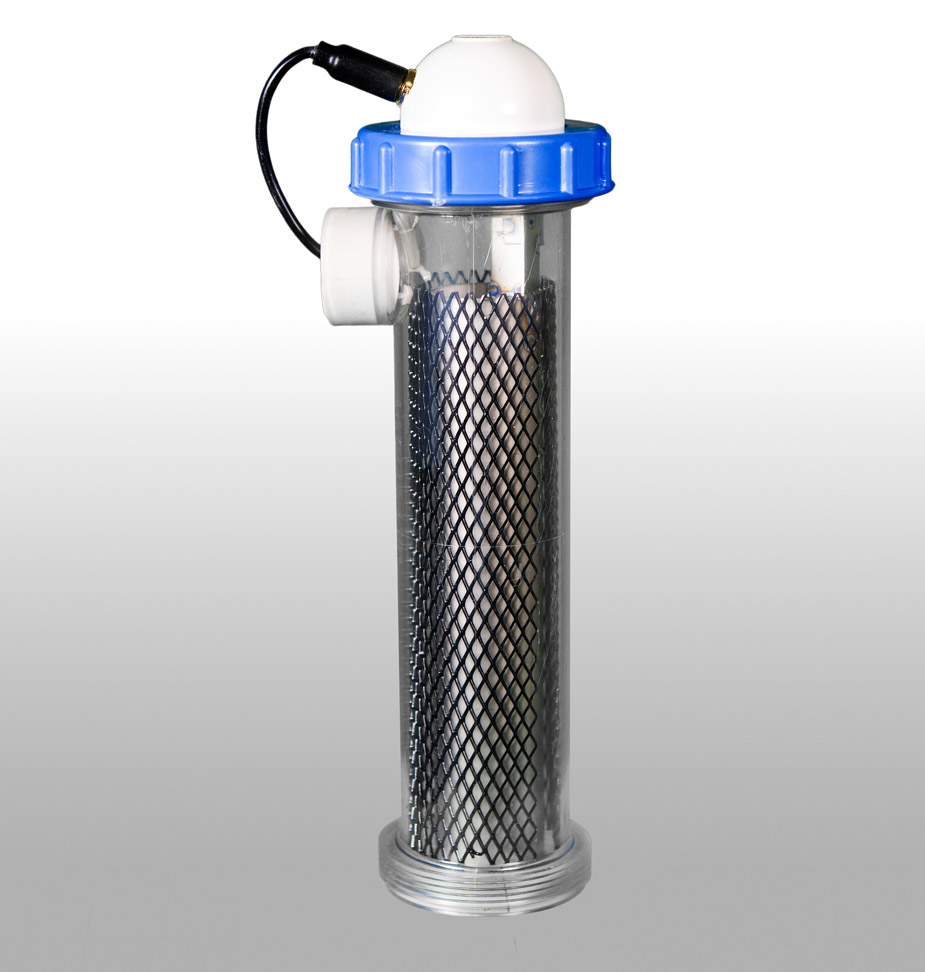
In the cell, the electrodes are splitting the salt and at the same time they are splitting the water to produce hydrogen and oxygen.  It is this hydrogen/ oxygen gas that makes a salt water cell dangerous.  In a Watermaid, water flows up the cell between the clear outer tube with the mesh anode, and the inner titanium tube (cathode).  It rolls over the top of the inner tube and then down the centre of the titanium tube and ejects into the bypass water flow.  As the water rises a current is passed through the water to generate chlorine.  If you look, you can actually see the cloud of hydrogen/oxygen and chlorine coming off of the electrode.  It mixes with the water and flows out to the pool.  If the water flow slows down too much in the cell, you can get a bubble of hydrogen/oxygen at the top of the cell.  If the water flow is too slow, the bubble will start pushing the water down in the cell.  If the cell was mounted horizontally, the gas could find its way down to the pool and build under a solar cover or go back and fill the filter.  This can be an explosion hazard.  Other manufacturers address this concern by putting a paddle switch in the water flow to sense when flow slows too much and shut down the cell.  In Australia It is a code requirement to have a gas sensor (like the paddle switch, or our gas sensing tang) but it must also have a gas trap as well.  If you picture the Watermaid cell, it stands upright to meet this requirement.  The safeties in the Watermaid work like this.

-The chlorinator is wired with the pump.  If the pump is selected on the Watermaid unit will have power.  If the pool pump is selected off, the Watermaid unit is powered off no matter what the switch position of the unit is.

- The cell stands upright so if water flow isn’t sufficient to carry away the gases, the water will be forced down in the cell.  Once water pushes down past the gas sensing tang at the top of the cell, the tang will not be able to see stray voltage from the electrodes any more and the unit shuts down power to the cell.

- to meet the gas trap requirement is easy for the Watermaid cell.  If the pump to Watermaid electrical connection isn’t correct or if the water flow slows for any other reason than pump shut down,  the gas tang is there to shut things down.  If for some reason the gas tang doesn’t work, the gas will continue to build in the cell and force the water further and further down the cell until the water finally is pushed past the electrodes.  At this point no more gas can be generated by the cell.  This is the gas trap which is an Australian code requirement.  If you have a horizontal cell in Australia, you need to put an upside down u in the plumbing with the cell at the top.  The pipe would go up one foot turn and go through the cell and then go down a foot and turn to continue on to the pool.  It is a lot of plumbing and it takes up a lot of space.  The paddle switches used by other manufacturers are not as reliable.  They tend to calcify and stick or break rendering them useless as a safety device.

There is no code requirement to have a gas trap in North America.  When a filter explodes and it takes out half of a house and kills someone I am sure that we will see a requirement here as well.


Mark

Posted in Saltwater Pools | 1 Comment

Why Does Watermaid run at a higher salt level than other salt systems

Watermaid is going for comfort.  Our body salt level is about 9000 parts per million.  In fact the first 9 months of our existence we swam around in a 9000 parts per million pool ( moms tummy).  We have some therapy pools (most are medical facilities) that actually run a perfect isotonic solution of 9000 parts per million.  The down side to that is it will taste like  tear.  For most pools Watermaid runs a salt level of 6000 parts per million.  The water isn’t as salty but then again it isn’t quite as comfortable either.  Watermaid doesn’t usually go lower than that for a couple of reasons.  First you are loosing comfort by going lower and a lower salt level will see a constant pH drift.  By holding a higher salt level you don’t split as much water and drive off hydrogen which pushes pH up.
Other manufacturers run a lower salt level because it is cheaper to produce the power supply.  At higher salt levels there is considerable load on the power supply and it needs to be built to take that, and it costs money.
They defend themselves by claiming that they are less corrosive and you can save on salt.  The reality is, a 6000 parts per million solution is 1% less corrosive than a 3000 parts per million pool because there is less oxygen in solution at 6000 parts per million.  You also need to keep everything in perspective.  6000 parts per million sounds like a huge number.  In fact it is slightly more than 1/2 of 1%.  a 3000 parts per million solution is slightly less than 1/2 of 1%.
We swim in our pool for enjoyment.  For that reason we heat it and keep it clean.  We feel that salt level is a huge part of pool comfort.  If you get a chance to swim in a 6000 parts per million pool compared to a pool that runs lower salt levels, We are sure that you will understand why we do it.
Posted in Saltwater Pools | 1 Comment